Showing posts with label human evolution. Show all posts

Thursday, 3 September 2026

1: We never were cavemen!

Homo sapiens never chose to live in caves, they’re horrible places. Caves are only useful in extreme weather, hot or cold, and then only for a short time. But what of all the evidence of occupation over centuries, of all those middens? Well, surely the evidence is just as consistent with one, or two weeks of occupation per year?

It is an ongoing contention of this blog that the evidence we have of our ancient hunter gatherer ancestors is not in the least representative. Despite the colossal increase in finds in my lifetime, we are no further forward in our understanding than we ever were. That which is both preserved and accessible to us now, gives us a highly distorted view.

So, what of the rock art? That which is found in caves is exceptional, literally. Imagine that everyone in a hunter gatherer band was multi-skilled, every child leaving their hand print wherever it would stick. Every adult, a craftsperson of necessity, and in idle moments, using any rock face to hand, having a go at simply leaving their mark, their representation of life. Art may have once been everywhere, then eroded by time, by wind, rain, snow, ice. Unexpectedly stuck in a cave, for who knows how long, waiting for a change in the weather, short of food, short of purposeful activity, any wonder some were obsessed with the distraction of art.

I say ‘band’, by which I mean at most 150, usually no more than 100. I’m very keen on Dunbar’s social brain hypothesis, and will push it further than he intended – or perhaps just state the implications more bluntly! (Along with my own combination of old school sociology learnt in the early 1980s, later explorations of Neo-Darwinism, and the more recently emergent social neuroscience.)

It bothers me the way researchers interpret what I’ve come to regard as unrepresentative evidence. Jumping far too far ahead. We are still in the territory of speculation, of the generation of ideas. After all, we remain essentially the same people, quite capable of placing ourselves in what we know of their situation!

For our ancient ancestors time and distance were much the same thing. The future was ahead. Would they reach the horizon they could see, today? Behind them was where they had been, not just where they had slept the previous night, but where they’d left their ancestors a long way behind, who, though they may speak to them still, were always over their shoulders.

Only later did farmers build henges, when they’d lost the ability to tell the time and to navigate. Agriculture was not the key; it was permanent settlement! When you stay in one place, you must watch time, and endure the cycle of the seasons. Agriculture is a failure to adapt to natural environmental change; it is an attempt to transform the environment instead. Dominance over nature is the most dangerous of memes, a misconstruing of the role of homo sapiens as the top predators on the planet. Pursuing an end to scarcity is folly and warfare an invention of those with territory to defend.

There are no straight lines in nature and only what is a threat is ugly. Permanent settlement led to a change in psychological time which persists today. Just as for our hunter gatherer ancestors there was a time-distance equivalence; later peasant societies (subsistence agriculture) often displayed a cyclical view of time. The past repeated in a landscape that seemed to stay constant, all that could happen had happened before, all that could be known is known. But in the modern era time seems synonymous with the progressive. Everything is built upon the previous, and assumed to be an improvement. The possibility of some things being done better in the past is excluded. However, there is nothing inherently progressive about evolution, whether biological or cultural!

You only start worshiping things you are dependent on and have reason from time to time to fear. We are a social species, our greatest desire is to belong. So in modern times when forced to be alone the narrative becomes ‘no one walks alone’ or a ‘ghost on the road’ story. For me, there may have been an ancient evolved spirituality, a once shared unconscious, growing out of our fundamental nature as a social species, living in small groups and being highly dependent on each other’s skills, moment to moment.

Over your shoulder, from the past, are the ancestors from whom wisdom can be acquired and therefore their presence changes how you behave. And there is no reason to feel learning from spirits shouldn’t manifest the same way we learn from the living; mirror neurons, imitation and memetics!

The move from a grounded spirituality to a religion happens when, forced to stay in one place, the head goes up beyond the birds (who tell you what is happening on the ground) to worry about the weather and imagines it is in the gift of other-worldly forces. It is a common assertion that astronomy breaks with astrology sometime during the scientific revolution, one wonders how it ever got started. Perhaps astrological beliefs were added by permanently settled agriculturalists when they realised they were trapped, tied to the land.

The night sky might have been our original navigation aid. I’m attracted to the phenomenon of ‘double sleep’ in a natural sleep cycle, and the notion that it is natural to have a period of meditative wakefulness at night. If this were true for our ancient ancestors, then every child, perhaps unconsciously, could have absorbed a mental map of the sky, including not just annual celestial cycles but the added weekly/monthly layer of the change caused by the distance they had travelled.

A golden thread of modern religions we are told is to do unto others as you would have them do unto you. Closely aligned with putting others first and centre in your life. But these ideas remain aspirations because the whole species does not cooperate. But think smaller, the band or village, the extended family, the hunting party. We evolved to operate as teams in which cooperation and competition are two sides of the same coin; you see an opening, you take it; you don’t, then give the ball away.

Such speculations as the above began in my youth when wandering across Dartmoor as part of small groups. I started to ask myself whether this landscape was really a wilderness at all, barren in parts certainty, but evidence of human activity was everywhere and had clearly been occurring over very long timescales. Even the bogs we were trying to avoid were evidence that there had once been trees. Later, I learnt from authors such as W G Hoskins that it is truly a man-made landscape, and studying Geography and Geology in sixth-form told me it hadn’t been a genuine wilderness since before the last forest grew - back at the end of the most recent ice age when it had been arctic tundra. As the climate warmed again the arboreal forest returned and hunter-gatherers came back from the south, the trees weren’t under serious threat till thousands of years later when Bronze Age farmers developed an insatiable desire for wood, not least for the making of hotter fires to produce even harder metal that could cut down even more trees, even faster.

(photo by Maria Margato 2008)

For the real story of hunter-gatherers in Devon we should turn away from Dartmoor and look out to sea, to what has become the English channel but was once a massive river plain and estuary, when the Seine, Rhine and Thames were its tributaries. The story of the decline of hunter-gatherers and the rise of agriculture after the last ice age is also one of sea level rise. From the top of Dartmoor tors, all the way to the current coastline there was dense forest, occasionally visited for resources, but not the preferred landscape. At the height of the last ice age sea levels were between 120 and 130 metres lower. And despite the forbidding nature of undersea archaeology, the whole story is there to be uncovered in the future. Our gaps in knowledge relate much to what is supposed not to have been preserved, worked wood, hide and sinew – the sorts of things preserved in alluvial river deposits, later covered by the sea.

Much of our knowledge about the Palaeolithic period is highly contested, but much isn’t and therefore taken for granted in current debates. My contention is we are a lot less further forward than we like to think. The temptation to quantify, in order to justify and maintain someone’s status, distorts much which should remain at the more fundamental level of qualitative evidence and debate.

Friday, 27 April 2018

Natural mental health (part one)

Introduction

My preferred way to meditate is to walk, but then walking is the most common and natural activity of the human species, it is what we evolved to do.

The basic elements occur naturally too, one following from another. First by focusing on the breath, it dictates an open upright posture, and balance comes from knowing that the centre of the body resides in the diaphragm along with the breath. In motion the focus shifts when the eyes are allowed to rise naturally to an open horizon; not a point of constant attention, but the place they come back to again and again as you let-go of distracting emotions and thoughts - from a past which is gone (behind you), and a future that is unknowable (beyond the horizon). With the eyes to the horizon and with good posture, then the feet will start to follow the contours of the ground and as if by magic, a ‘bodyscan’ occurs all on its own, as the right muscles are stretched, and then relaxed, along with stressful feelings and thoughts. A ‘mantra’ can be found in the pace and rhythm of the stride, but it must be flexible enough to change in an instance, for walking consistently and repetitively will soon narrow the horizon and an open future.

A connectedness to the world around us, of others and things, should be our moment to moment pre-occupation. We cannot see others as they are, if we are preoccupied with ourselves. The origins of spirituality or religious experience may lie with making others, and or other things, rather than one’s ‘self’ the central focus of our lives, allowing for transcendent experiences – a going beyond our usually limited perception of others. Equally, in the past there must have been a time when we were all very effective meditators. In some sense it must be a natural state, for it is hard to imagine our hunter-gatherer ancestors being able to survive without such skills. Think of hunting; of long hours on one’s feet, of the constant gentle movements needed to pick up a trail, to track and stalk, feel movement in the air, the physical coordination, the ability to navigate, feel the sudden stress of real danger, but be able to let go when it passes, the need for so much stillness, and the quick flowing response. And afterwards, to squat for a while under a tree, within the only real temple there is - not enclosed by the buttressing of branches but open to the vaulted sky beyond. And later still, the making of fire, the focus of community and our collective narrative.

8,34  20.7.2016 (photo by Nick Hewling)

The brain and body are so intimately connected it makes little sense to separate them when conceptualising mental wellbeing. Indeed the process of mental mapping which creates enduring neural pathways in the brain, and imposes habits of behaviour, evolved from the sense data coming from all our five senses as we move and grow in a landscape. The appropriate ‘treatment’ for mental distress may well be a physical one. When in the presence of someone who is ‘psychotic’, how often do we understand the content of their words? Better to pay attention to the body; the tone of voice, facial expressions of emotion, gestures and body movement. What would a physiotherapist see observing a client in their own territory away from the clinic or hospital? Suppose on encountering someone for the first time you ignore their apparent mental problems, offer just physical relaxation techniques, enforce a regular but limited sleep pattern, strictly control their diet and everything else they put in their bodies, and wait. Introduce mindfulness techniques for better anxiety and stress management - for greater mental awareness. After a week or so you may well be left with someone with enduring communication problems, a blocked ability to empathise and a limited ‘theory of mind’, but visible, through their nonverbal behaviour. Reintroduce one of the most powerful communication tools of all, touch. Allow the mentally distressed to learn, or more often relearn to be intimate with others. And you teach them to play again, to gain ‘balance’ (physical coordination) and the ability to ‘navigate’ (in space and time) in that social landscape of others. But all this would of course require staff willing and able to model and demonstrate natural and desired forms of behaviour.

A cold but awake body is physically and mentally stressed, warmth is relaxation - too hot and you are anxious. The mind and body are always on a positive feedback loop! Health in body and mind are the same thing. The source of health lies in natural environments – where only the unhealthy or threatening is ugly. We evolved to be outside and on our feet all day, with our eyes coming to rest on the horizon, catching the sun. Depression is entombing oneself all day, with a slumped body posture and nothing but artificial light, consuming more calories than you use up. It is about having a fixed territory, being stuck in one place and one time, and defending it in both a mental and physical sense. Mental wellbeing is about being happy with movement, change and uncertainty. It is not a sign of progress that the modern world is able to offer mental healthcare, rather it has become necessary since we started transforming our natural habits and ways of living. Anxiety and the heightened awareness that goes with it, is the normal response to perceived danger - the natural reaction is to freeze (the predator notices first the moving object), take flight or in extreme situations, fight. In the absence of real danger, anxiety should rapidly fall away. It is normal to fear the unknown, ‘outsiders’ or ‘strangers’. Anxiety is part way on the continuum from happiness or joy (loss of self-consciousness) to intense fear. A misplaced fear of others in the modern world, or the inability to attribute fear to the right people (or human artefacts) is what makes others appear as permanent strangers, outsiders or simply mad.

Most communication is nonverbal and unconscious, but with training can be consciously observed and a conscious nonverbal response given. But the meaning of any communication is the message received. You can only be conscious of a tiny fraction of what your brain is doing in any one moment, including thoughts and emotions. There are severe limits to what any one individual can objectify. In a sense you can only ‘know’ your own character by what you put into your body, and by the kind of people you spend your time with! The best diet for physical and mental health is probably still a pre-agricultural one, certainly the absence of refined sugars, cultivated and grounded grains, dairy products and domesticated animal meat. An inability to navigate with sight, sound, touch, smell and taste, is a fundamental element of what some call psychosis. A lack of balance, from not being able to rest the eyes on the horizon and feel the natural contours below one’s feet due to the modern built environment, shows in the long term mental as well as physical ‘crippling’ of the body.


History Seen Through the Wrong End of the Telescope

We are a social species and everyone’s greatest natural urge is to belong.

The natural mind has a nonverbal purpose in life, it notices signals, may or may not accept them as cues to action or as indicators of how others intend to act - though not necessarily how they are thinking; it allows us to decide whether others are comfortable, being honest with themselves or us. Verbal pronouncements are often just an explanation that satisfies the speaker and not us - they occur after the fact, and are not a cue to action.

Happiness or joy, is our baseline or default emotional state, the point to which we return when experiencing comfort and any stressors have been dealt with. Not being focused on joy, not constantly letting go in order to returning to it, is the measure of how far we are from nature. It is the lack of self-consciousness first experienced in childhood play. Nonetheless, joy still has to be found or remade every day.

Once upon a time our biological ‘social brain’ had an equivalence in culture, a ‘collective mind’ of shared and sharable information, the distance between the two now is one measure of how far we are from nature. Much of what we call nurture in the modern world, is a partially successful attempt at learning to suppress natural instincts. The most successful in society (the most mentally and physically healthy) are those who manage to resist or let go of such learning.

If we could learn mentally healthy behaviour without ever understanding its meaning, or indeed being conscious of learning it – would it matter? For there really is only one mental health problem – chronic stress (physical as well as mental) caused by our learnt inability to behave naturally around others, leading to cognitive and emotional isolation. The entire spectrum of phenomena observed and listed by psychiatry under its numerous categories can be seen as an expression of this basic truth.

A social model of mental health however needs to be set within and be consistent with a broader model of socio-cultural evolution. The rules of Darwinian evolution by natural selection hold - individual behaviour (action) is the subject (not personal meanings or explanation) and we should always look first at adaptation in specific environments (social situations). Situations change rapidly, within them there is always individual variation and selection from minute to minute, where a ‘personality’ only persists in so far as an individual acts today to try and reproduce their world as it was yesterday - a collection of routines, habits and addictions (skills learnt through repeated practice) which will be daily frustrated to the extent that they fail to be flexible in the face of change. The winners (those who forever return to the human default emotion - happiness) are those who can learn new (better) habits and allow existing ones to whither through lack of use. Such learning is socially neuroscientific insofar as an individual’s mental maps (made up of established, reinforced and discrete neural pathways) can add new connections imitated from other brains, and let go of existing habits, slowly allowing them to become dormant. Change usually comes uninvited, but we are pattern making machines. However, the healthy (successful) are those who are most willing to observe and adopt new habits (of thinking and emotional response through action) in new situations. The level of an ‘outcome’ for anyone in mental distress is directly proportional to their ability to undertake new learning.

Saturday, 24 December 2011

Prep (updated 2019)


 'In the early stages of learning to navigate naturally, time spent investigating puddles is rarely wasted. The key is always to think about the surroundings, to understand the sun's effect, getting to know its different arce in summer and winter, thinking about the shape of the surrounding ground, the wind and rain, and then trying to understand what can be deduced.' Tristan Gooley ( View on Amazon )


 'We stopped evolving and adapting when food was scarce and life was full of arduous physical activity. Hence, our bodies instruct us to eat everything we can lay our hands on and exert ourselves as little as possible. ..most diet and exercise advice is pointless. To move more and eat less is a direct contradiction of our genetically engineered impulses. Our forager ancestors would seek high-energy (meaning high-calorie, high-fat) foods that could be obtained at the lowest energy cost. They would eat or not depending on what they could find or kill, meaning mealtime was a fairly unpredictable thing. They would move when hungry (or when being pursued) and relax once fed - like wild animals today. Their movements would be sporadic, meaning short periods of intense activity (hunting, hauling, climbing, running) separated by long stretches of languid rest and play. There would be unpredictable intervals of low food intake... ..As far as our genes are concerned, this is still the way of the world.' Arthur De Vany ( View on Amazon )


 'I am sure many of you are familiar with the phrase "fight-or-flight response," which is common terminology used to describe the way in which we respond to threatening or dangerous situations. Unfortunately, this phrase is only two-thirds true and half-assed backward! In reality, the way animals, including humans, react to danger occurs in the following order: freeze, flight, fight. If the reaction really were fight or flight, most of us would be bruised, battered, and exhausted much of the time.' Joe Navarro ( View on Amazon )


 'When we go into a forest that has not been interfered with by man, our thinking mind will see only disorder and chaos all around us. I won't even be able to differentiate between life (good) and death (bad) anymore since everywhere new life grows out of rotting and decaying matter. Only if we are still enough inside and the noise of thinking subsides can we become aware that there is a hidden harmony here, a sacredness, a higher order in which everything has a perfect place and could not be other than what it is and the way it is.' Eckhart Tolle ( View on Amazon )

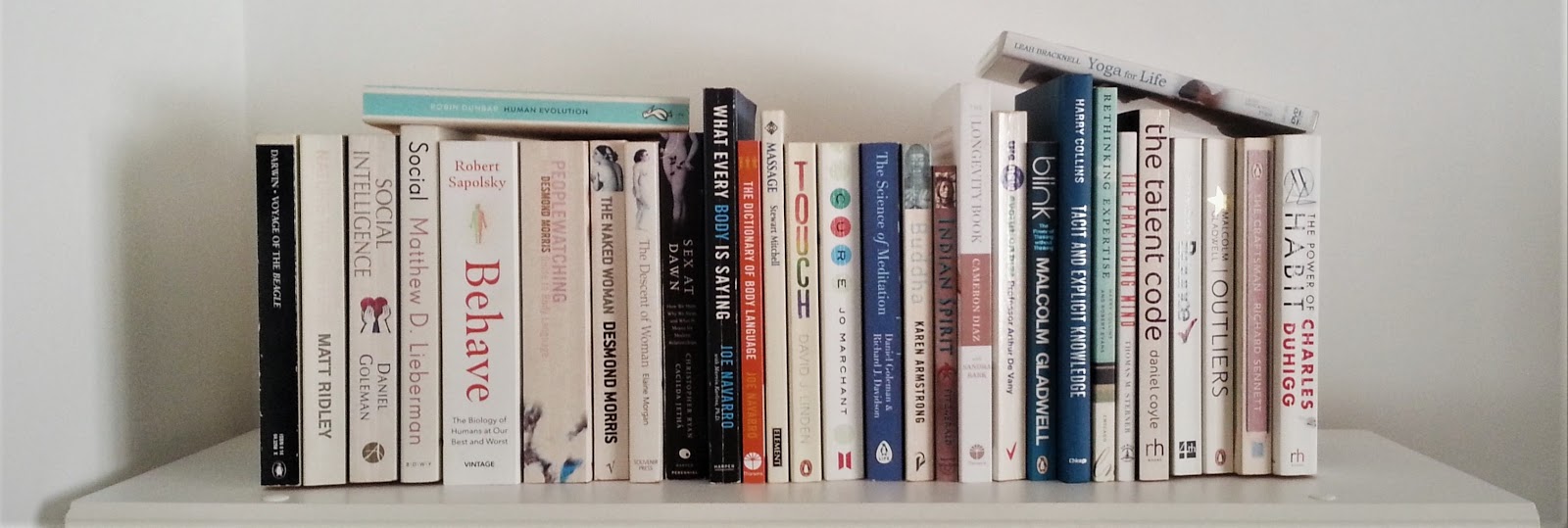
Full reading list 2019 (photo by Nick Hewling)

Selected reading list 2019 (photo by Nick Hewling)